Saw on TikTok that this is a high-school problem in New Zealand — calculate the area of the shaded region. It looked like it should yield to a bit of trigonometry. The blue lines below are helper lines I added.
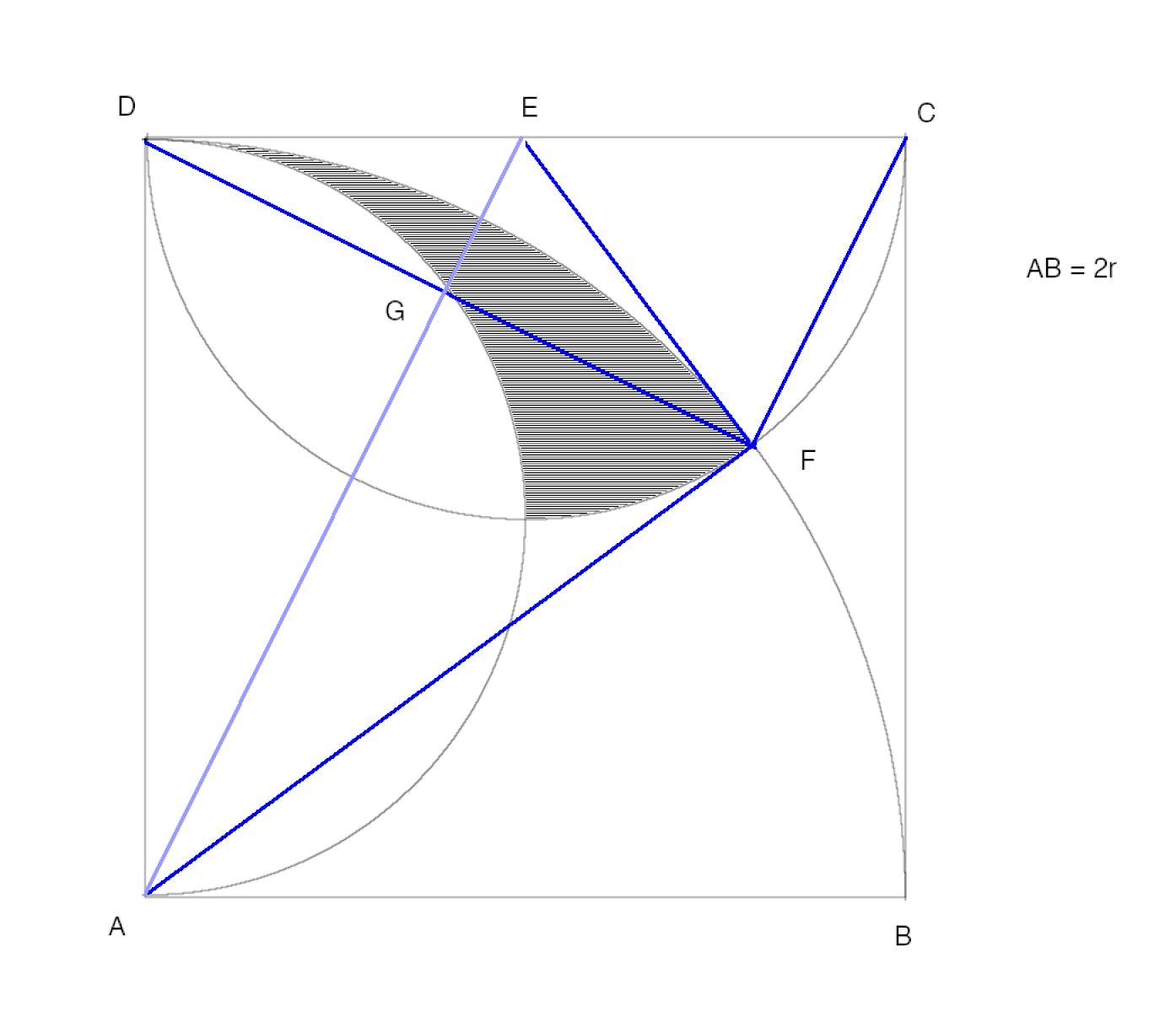
To get the shaded region, area b, we can take the area of the half-circle minus areas a and c.
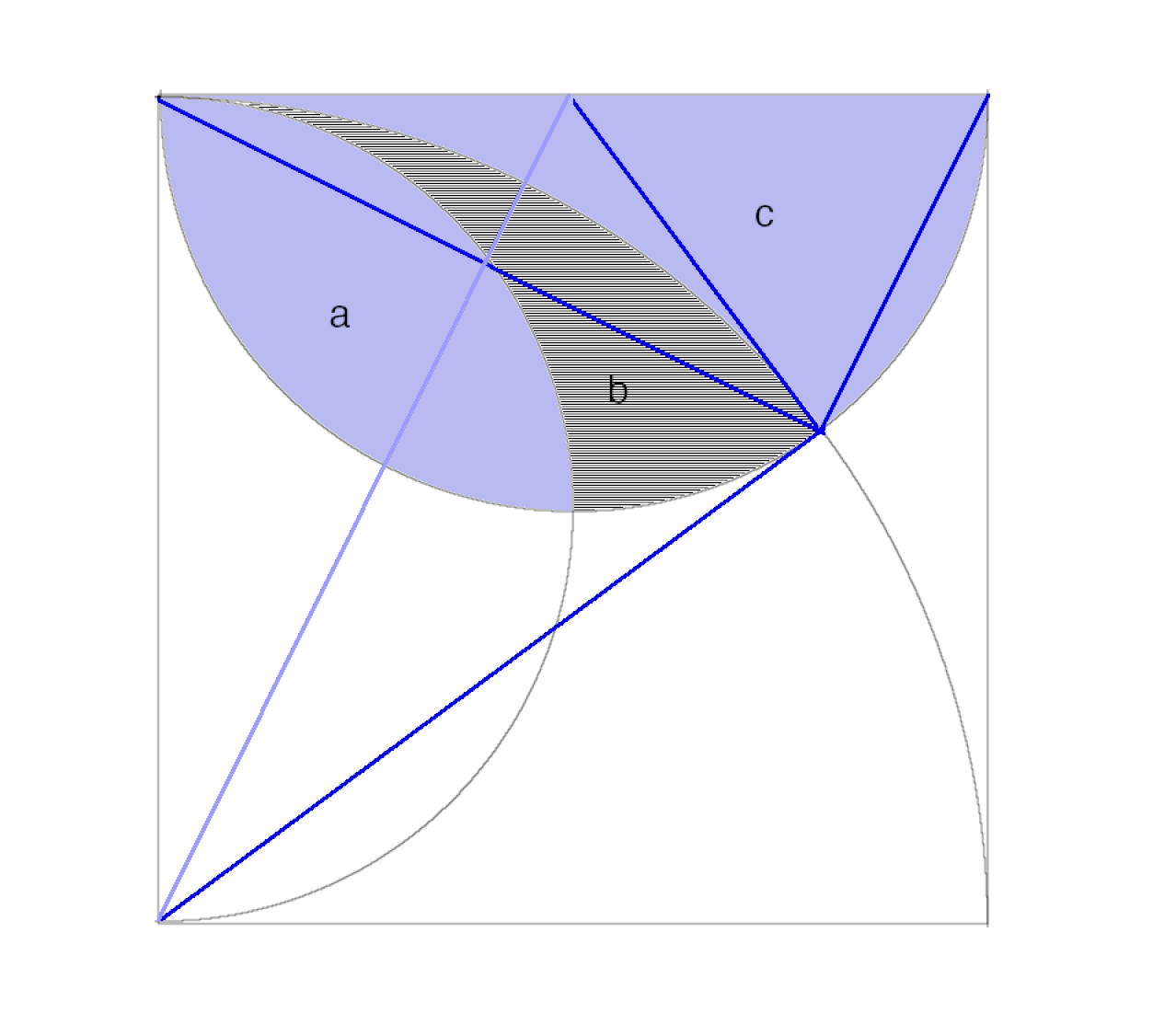
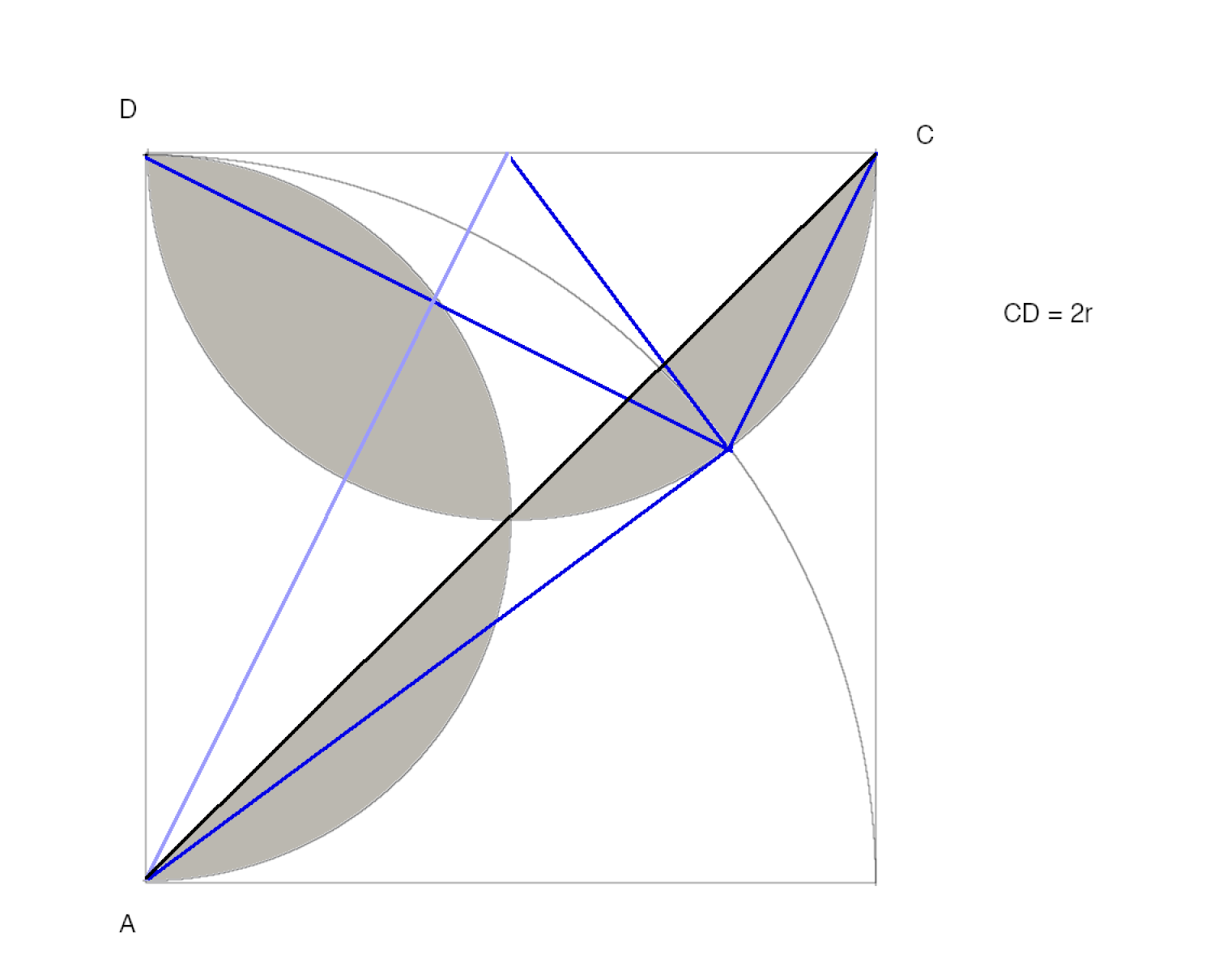
Area a is easy. It equals the circle area minus triangle ADC, divided by 2:
Sa=2(π−2)r2
To get area c, we use area of DFC minus area e plus area f. Because triangle DAF is similar to EFC and AF = 2·EF, we know area e = 4·f.
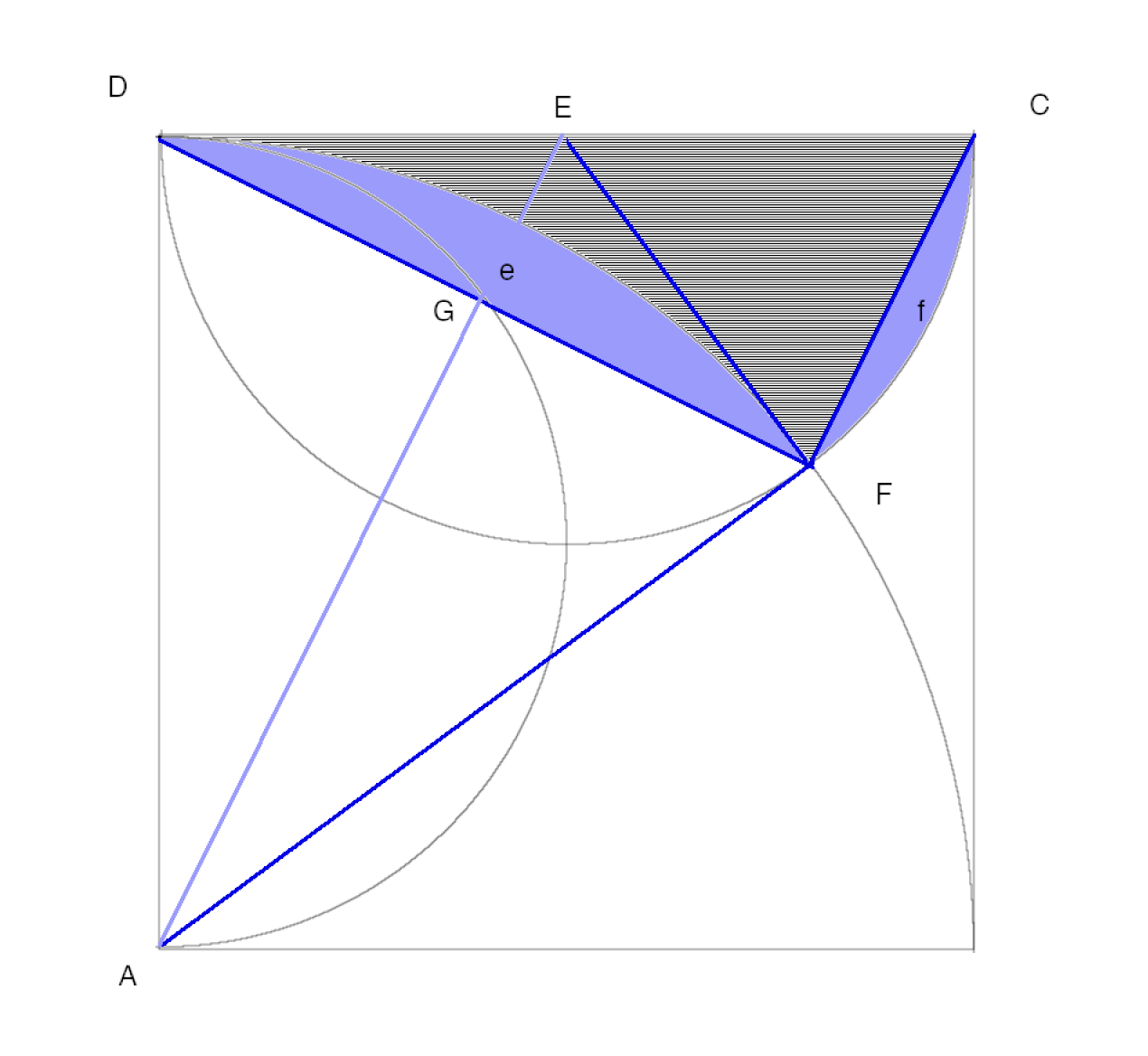
To find area e, take the circular sector ADF minus triangle ADF. The angle ∠DAE equals arctan(0.5), so the sector area ADF is (2r)² · π · 2·arctan(0.5) / (2π), which simplifies to 4·arctan(0.5)·r².
∠DAE=arctan(0.5)
S⌢DAF=4arctan(0.5)r2
For triangle DFA, the area is DG · AG, where DG = 2r·sin(arctan(0.5)) and AG = 2r·cos(arctan(0.5)):
S△DAF=4r2sin(arctan(0.5))cos(arctan(0.5))
So area e:
Se=4r2(arctan(0.5)−sin(arctan(0.5))cos(arctan(0.5)))
And since e = 4·f:
Sf=r2(arctan(0.5)−sin(arctan(0.5))cos(arctan(0.5)))
The area of triangle DFC equals DF · CF / 2. By similar triangles, CF = DG = GF, so:
S△DFC=4r2sin2(arctan(0.5))
Now area c = DFC − e + f:
Sc=4r2sin2(arctan(0.5))−3r2(arctan(0.5)−sin(arctan(0.5))cos(arctan(0.5)))
Finally, b = half-circle − a − c:
Sb=2πr2−2(π−2)r2−(4r2sin2(arctan(0.5))−3r2(arctan(0.5)−sin(arctan(0.5))cos(arctan(0.5))))
Simplified:
Sb=r2(1−4sin2(arctan(0.5))+3(arctan(0.5)−sin(arctan(0.5))cos(arctan(0.5))))
Which comes out to:
Sb≈0.394r2